Japan Trip 2025 – An epic adventure!
Setting off in early November, 50 delegates from the global WIKF federation set off on an epic touring trip of mainland Japan, our first since the passing of Professor Tatsuo Suzuki. The British contingent, led by Sensei Jon Wicks (Su-Ha-Ri) and Sensei Andreas Michaelides (Ken Bu Kan) included a further four of us from Su-Ha-Ri: Christian, Jayne and husband Ron, and Simon. We joined the Americans, Belgians, Norwegians and Swedes at Narita airport for the ‘vengabus’ to downtown Tokyo, later joined by our friends from Greece. For most, the journey started Saturday morning, so with connecting flights and time difference, this meant a group meeting at 8pm sharp on the Sunday evening(!). The goal of the trip (not a holiday!) was to rekindle friendships in Japan and reconnect with our fellow sensei’s, coaches and WIKF family.
Monday 3rd November began in two groups: Most importantly, the most senior representatives attending a much anticipated and special arranged training with Sensei Kobayashi at his Tokyo Dojo, while the second group took the opportunity to reconnoitre and discover parts of the vast metropolis that is Tokyo. Specifically:
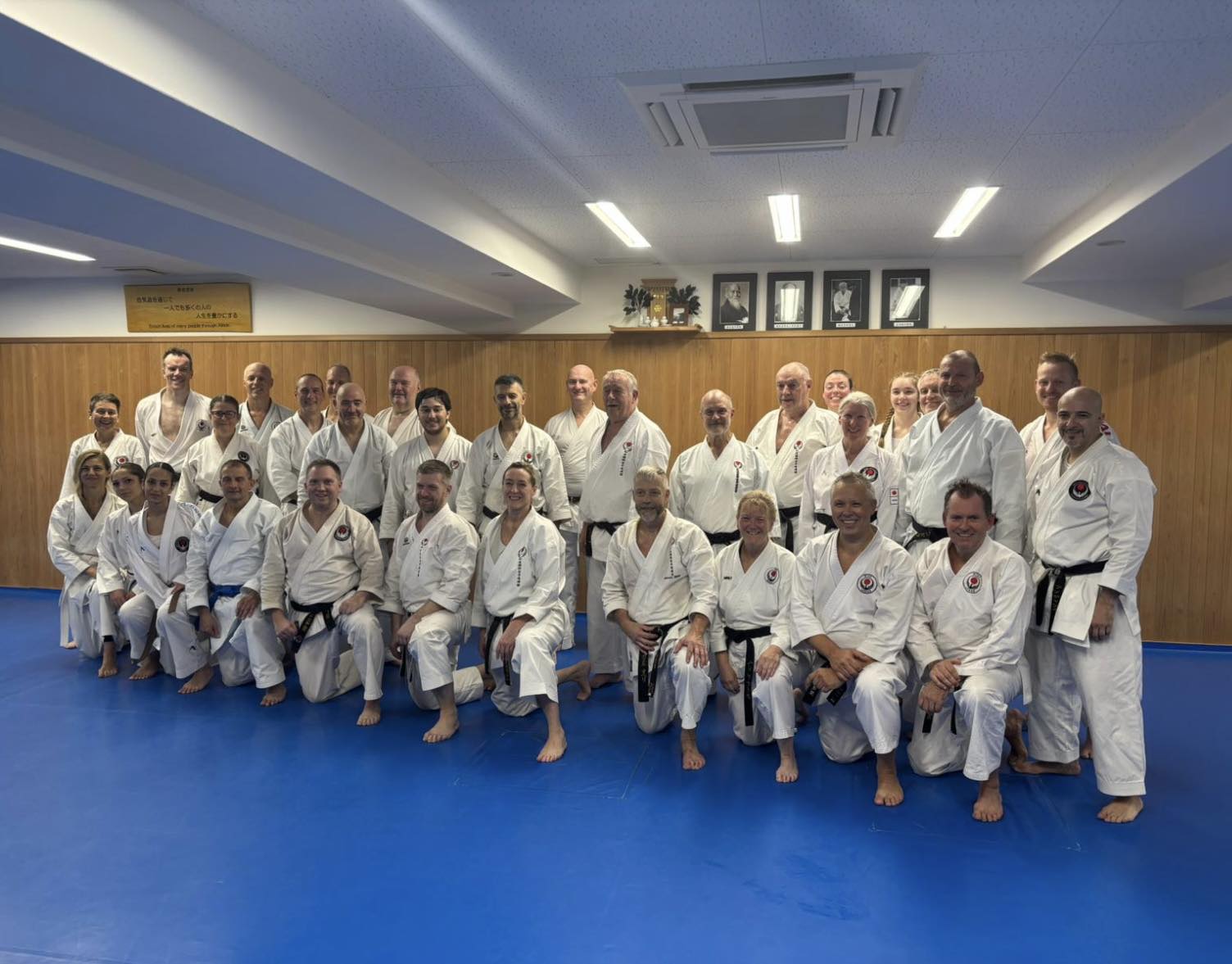
“Fifteen of us had the great honour and privilege to visit the Dojo of Koboyashi Sensei for a 3 hours training with Senior Karatekas from England, USA, Norway, Sweden, Greece and Belgium, including our World Chief Instructor Sensei Jon Wicks, our World President Sensei Mathieu Beysen and World Technical Committee members Arturo Girona and Angelos Gorgas. We were welcomed in with gifts from our hosts. Kobayashi Sensei took us through Kihon, combinations, pad-work and Kata and before we knew it we had spent 3.5 hours and we finished a great training session. We received a lot of compliments about the level of quality in WIKF, so we hope someone up there looked down upon us with the signal: “Not so Bad”. After the training Kobayashi Sensei together with his team and family gave us the warmest welcome we could expect. The dojo was reorganised and our gracious hosts provided a party with drinks and song and the extra honour of cooking for us. We also gave gifts and were able to really connect and reminisce about the past and discuss the future. Assisting Sensei was Kazunari Hijikata, who brought us the Nichidai tribute and song – and we recognised a realisation that WIKF felt fully accepted. When we finally left and returned tired but satisfied to our hotel we knew that the voice up there give us another signal… “VERY GOOD”. A special thanks must also go to Sensei Wicks who had spent many months co-ordinating and arranging this hugely appreciated session, a crucial one for us all.” It was clear that the success of this training gave everyone a great positive boost, it created a real buzz across the whole group as we went on to explore the full culture of Japan…
Training with Kobayashi Sensei 2025
In Tokyo, our hotel had a direct view of the Tokyo Skytree tower. The Brits took on some welcome culture: Hokusai art museum – the local artist famed for his 36 views of Mount Fuji – including the iconic ‘Wave off Kanagawa’ picture; then onto the sword museum, with samurai katana, wakizashi and tanto dating back to the 1300’s. The weather was warm, the streets were clean and the food was fast. Most restaurants had what I call ‘point and click’ menus – with pictures of the food on laminated books of dreams, posters on the walls and lifelike plastic replicas of the dishes (an artform itself). Both kinds of beer were available: Kirin and Asahi. That evening in the bar was a runaway success with some Karaoke classics: ‘Yesterday’, ‘Hey Jude’, ‘What a wonderful world’, ‘Everybody’ and ‘Somebody like this!’
Tuesday the touring began in earnest, we piled on to our two coaches with sightseeing guides - who proved both knowledgeable and entertaining. It started with a visit to Asakusa Kannon Temple at the far end of Nakamisa street from our first drop-off on the riverside opposite the Asahi HQ with the golden ‘flame’ – which has a rather different local name, then on past the Imperial Palace to Shibuya. Shibuya, famous for its large diagonal pedestrian crossing and the statue of a loyal dog, as well as a giant starbucks and a restaurant that served us a bottomless bowl of ramen. The afternoon meant a reluctant farewell to Sensei Wicks and a long coach ride up to the volcanic peaks north-west from Tokyo. An overnight at the Manza ski resort meant a chance to relax naked in the sulphurous onsen baths outside with a snow-covered moonscape to view. Nobody risked a naked Kata in the snow, but we did have a chance to don the local spa-wear, sporting the latest fashion in Yukata (a lightweight Kimono that made Andreas look like Joseph of Arimathea) and a Yukata over-jacket (which was far more sartorial).
Back on the coaches for the precarious snowy descent through the gorgeous pine forests and bright sunshine, we took the long route over to the coast avoiding the much larger Japanese alps and on to coastal Kanazawa. En route from Nagano we stopped to look at a stunning railway viaduct and dam over the Kurobe Gorge at Unizuki Onsen, enveloped by the Hida mountains of the Chubu-Sangaku National Park and cloaked in a patchwork quilt of autumn colours across the trees. At the Kanazawa city edge we then walked the Higashi-chaya (Geisha teahouses) district – no Geishas to be seen, but lovely traditional wooden housing streets used in scenes from the movie The Last Samurai.
A trip to Japan would not be complete without a visit to some stunning gardens – our choice was the Kenroku-en promenade pond gardens in Kanazawa. Technically a ‘Samurai’ garden of the Maeda Clan, it is counted as one of the top 3 great daimyo gardens of Japan. Monty Don’s series on Japanese Gardens included two visits here (spring and autumn) – and he was right to point out the attention to detail, the reflections of the tortoise shell island and the tree-supports and rope work that turn this place into a living work of art. There was enough space to separate from other tourist groups and find a quiet moment to reflect. Outside Kanazawa castle, many of us then rewarded ourselves with a green tea ice cream, clothed in edible gold leaf. Oishi!
A delicious lunch in the Omicho fish market, then a visit to the Nomura Samurai house and the surrounding streets of Nagamuchi – again soaking up the atmosphere, traditional crafts and culture of a bygone era.
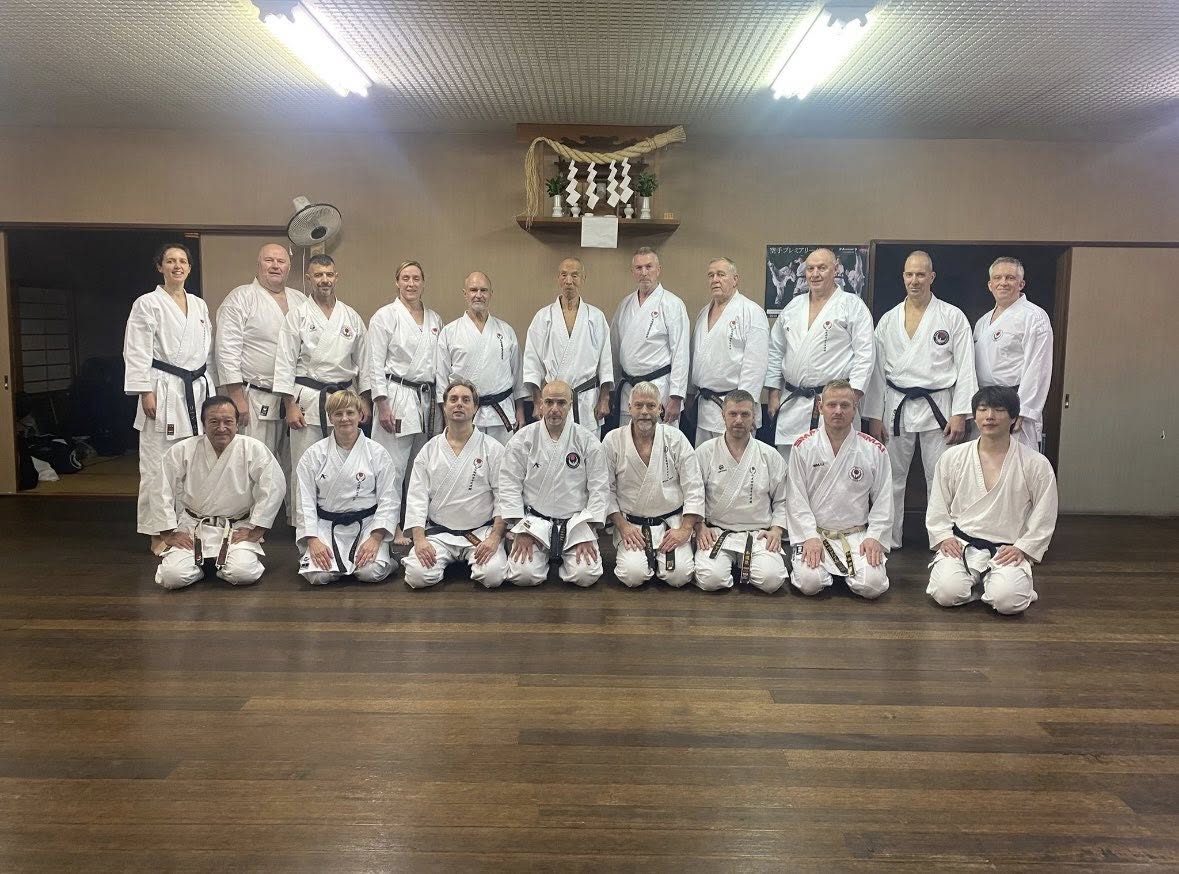
A coach trip across to Kyoto, the former capital city of Japan, meant a stay near Nijo Castle and a much-appreciated training session in a local Aikido dojo delivered by the World Technical Committee. This was a real bonus for the whole group and a chance to chain together some Kihon-gumite, alternating international partners after each set. Our thanks to Senseis: Angelos, Arturo and Mathieu. With the afternoon free, a number of us discovered the Golden Temple – a pavilion of a former Shogun, covered in gold leaf – creating a spectacular reflection in the surrounding pond. That evening three of us Brits celebrated with a formal Wagyu dinner organised by Per Berge from Norway – with his excellent Japanese language skills and wine choices. Jim from Norway continued the entertainment at the British Pub, also practising his skills on the unsuspecting Japanese (and Irish!).
Given the necessity to break into small groups for dinners, we started to get a little worried that we were not getting the whole group together socially. So we created a fun quiz across our two busses. Later, the Belgian ‘power-puff girls’ quiz team discovered a nearby hotel bar (‘Moxys’, or was it ‘Roxys’?) that could accommodate us all for the next few nights – resulting in lots of happy chat and another round of Happy Birthday to Sensei Cato.
On Day 9 we visited the UNESCO World Heritage site Himeji Castle. This was the only day it rained on the trip, but it added atmosphere to a strangely familiar place: It was used in the 1967 movie, You Only Live Twice, in which Bond is shown around the Ninja Training School and later, cunningly disguised as a local, marries the character Kissy Suzuki. Worth a re-watch, as well as Kurosawa’s movie ‘Ran’ (1985). Inside, the castle resembles a well-polished wooden ship with huge beams, large weapons racks and near-vertical stairs to climb up through to the 6th storey for views across the town. We returned via the harbour port of Kobe with views across Osaka Bay and of course famed for its beef, a type of Wagyu.
Next day in central Kyoto, Inari the Shinto god of rice beckoned us to the iconic Fushimi Inari-taisha Shrine. Several sizable bright orange and red shrine buildings set on a hill are then complemented with an 800-strong series of traditional gates called Torii, creating a long orange tunnel up the mountain. Some of us with an abundance of energy took a jog up to the top and back down – credit to Christian and the Norwegians(!). After some shopping in Nishiki market, Wagyu burgers that evening in Pontocho alley were divine.
We hit 295 km/h on the Shinkansen bullet train the next morning on our return to Tokyo, whereupon we took the chance to go up the Skytree tower - some 600m tall, the tallest non-residential tower in the world, with a dizzying view from its 453m platform. Our return flights the next day flew us over the Bering Strait, the Arctic Circle and Greenland.
In summary, this was an epic trip taking in the shrines, temples, castles, gardens, mountains and coasts of Japan. It was a lesson in navigating the giant metropolis of Tokyo, the not-so-small Kyoto area and the dizzying variety of unexpected foodstuffs. It was a genuine privilege to train in a Karate-gi in Japan, with a contingent of karate experience across the group that added up to over 900 years(!). It was a chance to have fun with our international karate friends, to strengthen bonds and to seriously reconnect with Japanese culture and philosophy – the very home of our martial art. Our special thanks again to Sensei Wicks and Sensei Beysen for co-ordinating and organising this adventure!
Look out for another unmissable chance to experience Japan with the WIKF – make a note in your diaries for springtime 2029!
Simon M
Group Photo